
2026 is a momentous year for the School for Dog Trainers, as it marks twenty years since our formation. Over the past two decades, we have welcomed dog trainer students from across the globe as part of our mission to improve the standards of dog training around the world – we have welcomed students from over 40 countries (including recipients of our International Scholarship).
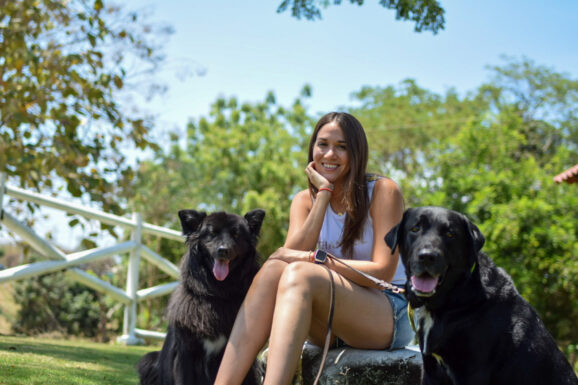
One overseas graduate from our programs is Melissa Vélez Schemankewitz from Ecuador. Melissa graduated back in 2021 from our Dog Obedience & Behaviorist Program. Five years on from her graduation, we caught up with Melissa to learn more about her dog training journey; what she gained from attending the School for Dog Trainers; and what her future aspirations are for her business.
(Looking for more Graduate Showcase stories? Check out our hub here!)
Please tell us a little about what your day-to-day looks like, in terms of training dogs.
I work in Obedience and Behavior Modification with families in a certain area in my city. I wake up early in the morning and go to different sessions until noon, then I come back home and work on my social media or other business related tasks. I resume my sessions in the afternoon until evening. I do mostly in behavioral cases where families deal with unruly pups and other bad manners at home, but ultimately mostly with aggressive and reactive dogs. I’ve had a lot of success with these types of behaviors, and many people recommend me since I am the trainer that “deals with those dogs”. I am not a fan of working with dogs with aggression or reactivity, but somehow, I became very good at it.
Of course, I enjoy working with puppies and other simpler cases very much. I would love to have more of those cases, but sadly my city has a lot of issues with dogs due to bad genetics and very low education about dogs and animals in general.

Could you tell us a little bit about your background with dogs prior to attending the School for Dog Trainers?
I grew up with animals. I had a German Shepherd, 2 Labradors, a Beagle, a Cocker Spaniel and a stray that we adopted when I was little. My family even had a horse at some point. I was the girl that would play with the animals that came with the Barbie; the Barbie or doll instead would be totally ignored.
I always wanted to work in something related to animals, and dogs and wolves were my favorite ones, so I wanted to become a vet. Sadly, the veterinarian career in Ecuador was frowned upon many years ago, and it had the fame of being a low-income job that wouldn’t help me become successful (crazy, right?). When I graduated from high school, I was advised against becoming a vet, and the University that had that career was too out of reach for me, so I decided to become a Clinical Psychologist. This would be the very foundation of my knowledge of behavior, and at that time I didn’t know it would help me tremendously with my dog training career.
I forgot about dogs for a while, since my last dog had died when I was 12 years old. Years later, when I was 27, I learned that dog training was something you could make a career of (if vets were something unpopular, imagine training dogs here? It was crazy to think that you could be a professional in that field), and since I always cherished dogs, it would make sense for me to dedicate myself to the behavior of the animal I loved instead of the humans. I fell in love with the industry and have dedicated myself to dogs since 2018.
How did you first hear about Highland Canine/School for Dog Trainers?
I was looking for schools in the USA and had many references from people here that had taken the career before me when it started to become a popular thing. I knew someone from Ecuador had taken a course at the School for Dog Trainers and decided to reach out and ask her about it.
Can you provide some insight into how your education at Highland helped you? How do you use what you learned at Highland in your day-to-day business activities?
One of the things that I loved in my course was visiting real clients and learning from the real scenarios. Corey would take us to different houses, and we would listen to the evaluations and reasoning behind his words. I remember one case that he solved by telling the family that the dog, that was currently being aggressive without any precedent, was simply stressed by another family dog that was visiting. Once you removed the new dog (that was a temporary visit), the client dog would return to normal. Until this day I always remember this case and analyze the whole situation; dogs act for a reason and it’s not the best decision to just “tackle” the symptom (the aggression) but rather go deeper and understand the root of the behavior, even if it becomes a task and a heavy responsibility for the owners.
Today's students at the School for Dog Trainers are graduating into an industry which is experiencing significant year-on-year growth. This obviously has many positives, but it also makes it a very competitive industry to be successful in. Do you have any advice for graduates from Highland who are thinking of starting their own business in this industry?
Nobody graduates and becomes a master. This industry is all about practice and learning from mistakes. As a graduate you will feel you know everything and at the same time you will feel you know nothing. Client dogs and people will challenge your knowledge, your patience, your will to continue, they will make you face parts of you that you haven’t worked out, and that is okay.
You will also get the “imposter syndrome”, it will make you feel you know nothing and make you feel like everybody else solves cases and you don’t. That’s normal, and it will happen. There is a saying or teaching in the aviation industry that says something like “fix it on flight”; once the plane is in the air, the crew has to handle any issue with the resources available on board. That doesn’t mean they aren’t prepared, but in flight, it’s all about adapting and resolving safely until landing. So, essentially, yes: challenges are solved in the air!
My advice is that you still do it, even if it seems hard. And if you think you can’t handle a case, the best ethical decision is to refer them out. That’s not something to be ashamed about.
What are your future aspirations in the dog training world?
My future aspiration that I am starting to build is to have a dog training school for future trainers, I love teaching and now I feel confident enough to help others become professionals. I don’t mind training a professional, that will be my competition because Latin America lacks schools for dog trainers. My goal is to have the best school out there in South America.